Thursday, October 21, 2010

Wednesday, October 13, 2010
Fall Happenings at Riverside Park
 The past couple of weeks have seen drastic changes at Riverside Park.
Continuing the work done by Gorge Stewards in May, volunteers from Aveda joined Gorge Stewards and FMR on September 29th. With the temperatures peaking in the mid 70's, volunteers worked hard in the sunshine removing several invasives, including buckthorn, burdock and motherwort. Manual removal and weeding prepared the area for planting and meant that the site would not need to be treated with herbicides.
This past Saturday, October 9th, nearly 40 volunteers joined ecologists from Ecological Strategies and members of the Gorge Leadership Team to follow up on the hard work of the Aveda crew. Getting their hands dirty in the soil, groups planted several species of native shrubs, grasses, and forbs (wildflowers).
 Digging in! Basking in the sunshine, volunteers dig a small trench around the freshly weeded planting beds to keep the turf from encroaching.
 Volunteers of all ages were present to restore Riverside Park. Recycled newspaper was spread around seedlings to keep out encroaching weeds, giving the natives a chance to thrive.
 Volunteers begin spreading woodchips around some of the 5 grass species and 17 wildflower species planted at the site.
At the end of the day, volunteers planted 63 shrubs - dwarf bush honeysuckle, meadow rose and wolfberry - and about 260 native grass and wildflower seedlings - little bluestem, blazing star, columbine, and more - and helped redefine the trail edge leading down to the beautiful Mississippi.

Once dominated by sprawling invasives, Riverside Park is going back to its native roots with the help of these amazing volunteers. Look for events in the spring for ways you can continue to help restore Riverside Park and watch these plants grow!
Wednesday, September 15, 2010
2011 Gorge Leadership Team
The Gorge Leadership Team, now in its third season, has expanded the range of their efforts to include sites on the St. Paul side of the river gorge. This year they had outings at Hidden Falls and Crosby Parks in St. Paul, in addition to working at the 36th Street oak savanna in Minneapolis.
St. Paul's Parks and Recreation Department asked for the team's help caring for a spring ephemeral patch at Hidden Falls Park. The team spent the evening removing narrowleaf bittercress, an invasive species that has only recently been reported in Minnesota but that is spreading at an alarming rate along the St. Croix and Mississippi Rivers.
They also pitched in at the prairie restoration project at Crosby Park, and helped tend the demonstration native prairie garden. The native grasses and flowers planted in 2008 have done really well, but so have the weeds! A small, experienced group of volunteers like the team, working with FMR's ecologist Karen Schik to decipher what was what, was just what was needed at the site.
 Members of the Gorge Leadership Team pose in front of the mountain of weeds they pulled from the demonstration prairie at Crosby Park. Photo courtesy of Karen Solas.
The team again had an important role in the management of the oak savanna, prairie bowl, and oak woodland at 36th St & W. River Parkway in Minneapolis. They continued their vigilant work to keep garlic mustard and buckthorn from taking hold, and tackled numerous other outcroppings of invasives, like sweet clover and reed canary grass. Some team members also helped remove graffiti from interpretive signage, while others freed dogwood trees from smothering grapevines.
 Team member Sara Muchoswki removes graffiti from an interpretive sign at the oak savanna. Photo courtesy of Karen Solas.
While the team's outings may be over for the season, many team members will be helping out at FMR's remaining public volunteer events, in the river gorge and beyond. These volunteers put in an average of 20 hours a season caring for the river, improving habitat and water quality. A huge thank you goes out to all the 2011 Gorge Leadership Team members for your incredible dedication and hard work!
 Team members Michelle Garvey and Fred Tyler remove sweet clover from the oak savanna. Photo courtesy of Karen Solas.
 Black swallowtail nectaring on sunflower at the 36th St. oak savanna. Photo courtesy of Carolyn Carr.
St. Paul's Parks and Recreation Department asked for the team's help caring for a spring ephemeral patch at Hidden Falls Park. The team spent the evening removing narrowleaf bittercress, an invasive species that has only recently been reported in Minnesota but that is spreading at an alarming rate along the St. Croix and Mississippi Rivers.

They also pitched in at the prairie restoration project at Crosby Park, and helped tend the demonstration native prairie garden. The native grasses and flowers planted in 2008 have done really well, but so have the weeds! A small, experienced group of volunteers like the team, working with FMR's ecologist Karen Schik to decipher what was what, was just what was needed at the site.
 Members of the Gorge Leadership Team pose in front of the mountain of weeds they pulled from the demonstration prairie at Crosby Park. Photo courtesy of Karen Solas.
The team again had an important role in the management of the oak savanna, prairie bowl, and oak woodland at 36th St & W. River Parkway in Minneapolis. They continued their vigilant work to keep garlic mustard and buckthorn from taking hold, and tackled numerous other outcroppings of invasives, like sweet clover and reed canary grass. Some team members also helped remove graffiti from interpretive signage, while others freed dogwood trees from smothering grapevines.
 Team member Sara Muchoswki removes graffiti from an interpretive sign at the oak savanna. Photo courtesy of Karen Solas.
 While the team's outings may be over for the season, many team members will be helping out at FMR's remaining public volunteer events, in the river gorge and beyond. These volunteers put in an average of 20 hours a season caring for the river, improving habitat and water quality. A huge thank you goes out to all the 2011 Gorge Leadership Team members for your incredible dedication and hard work!
 Team members Michelle Garvey and Fred Tyler remove sweet clover from the oak savanna. Photo courtesy of Karen Solas.
 Black swallowtail nectaring on sunflower at the 36th St. oak savanna. Photo courtesy of Carolyn Carr.
 Thursday, August 12, 2010
Brush Hauling at Upper Crosby Lake
We recently reported on an exciting new shoreline restoration project beginning at Crosby Park's Upper Lake in St. Paul. On Thursday, August 5th, about 30 FMR volunteers gathered at the park to help out with the first phase of this restoration, invasive species removal.
Invasive and non-native buckthorn had formed a thicket along the shoreline and was choking out all the native trees, shrubs, and plants. Saint Paul Parks crews had cut this brush prior to the event, and our volunteers spent the evening hauling it out of the woods and stacking it so that SPP staff could then pick it up and take it away to be chipped.
After a lot of sweat, mosquito bites, and stinging nettle, we had hauled enough brush out of the woods that some beautiful views of the lake and shoreline were opened up. While this is nice for those of us who hike in the area, it also means that native species will have the opportunity to thrive in these cleared areas.
 The piles of brush start to form!
 Smiling, energized volunteers - it will take more than nettle to stop them!
 One of the largest buckthorn "shrubs" removed - this one was definitely more of a tree!
 After removing the buckthorn brush, a group of volunteers uncovered this natural playground, including a perfect Tarzan vine...
 ... and a jump rope vine!
We are so exited to have begun this project, and to see how the shoreline is transformed and habitat improved at this important riverside park. Huge thanks to all the volunteers who helped out, and to St. Paul Parks & Recreation!
Invasive and non-native buckthorn had formed a thicket along the shoreline and was choking out all the native trees, shrubs, and plants. Saint Paul Parks crews had cut this brush prior to the event, and our volunteers spent the evening hauling it out of the woods and stacking it so that SPP staff could then pick it up and take it away to be chipped.
After a lot of sweat, mosquito bites, and stinging nettle, we had hauled enough brush out of the woods that some beautiful views of the lake and shoreline were opened up. While this is nice for those of us who hike in the area, it also means that native species will have the opportunity to thrive in these cleared areas.
 The piles of brush start to form!
 Smiling, energized volunteers - it will take more than nettle to stop them!
 One of the largest buckthorn "shrubs" removed - this one was definitely more of a tree!
 After removing the buckthorn brush, a group of volunteers uncovered this natural playground, including a perfect Tarzan vine...
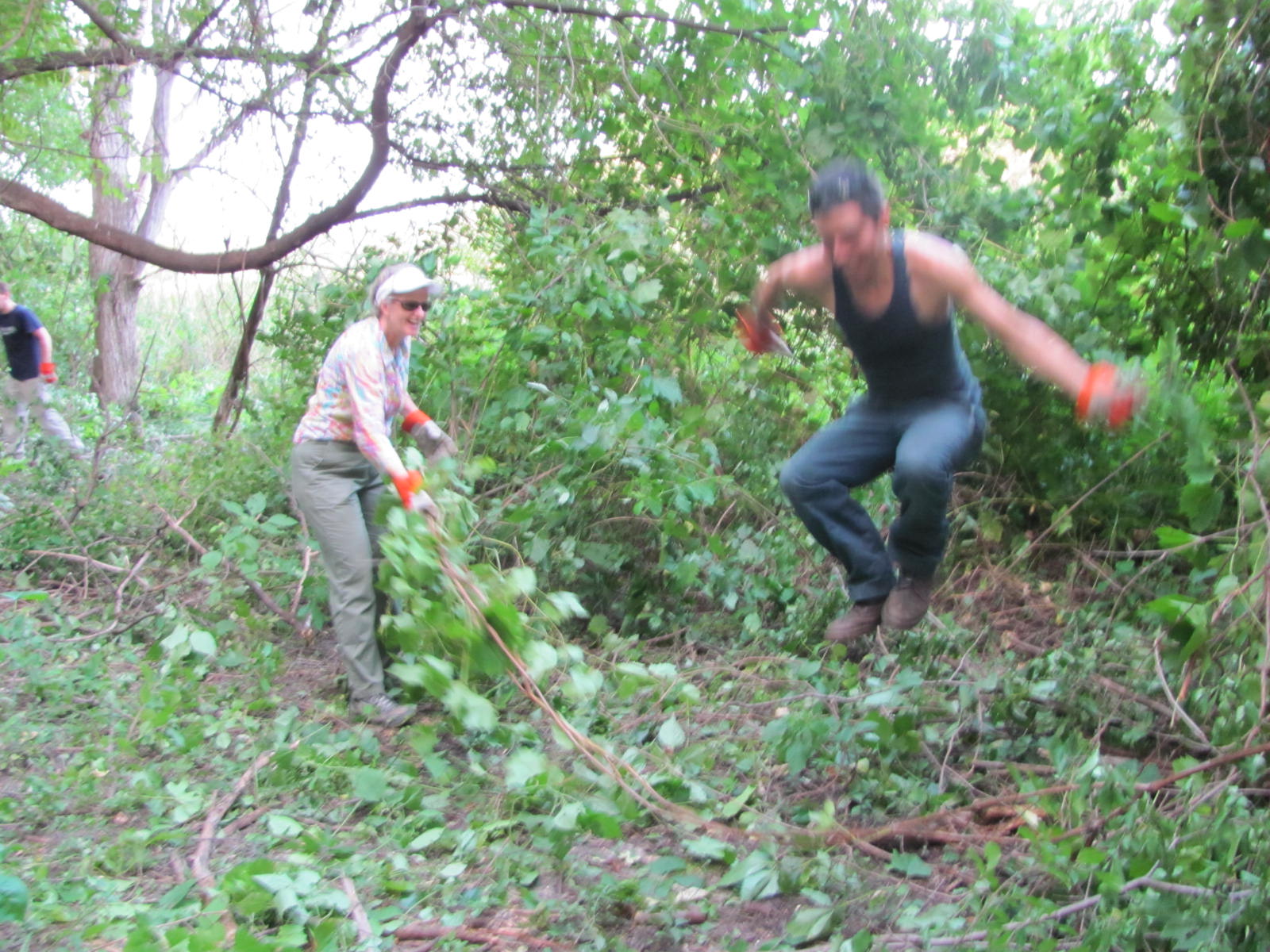 ... and a jump rope vine!
We are so exited to have begun this project, and to see how the shoreline is transformed and habitat improved at this important riverside park. Huge thanks to all the volunteers who helped out, and to St. Paul Parks & Recreation!
Tuesday, July 13, 2010
Shoreline Restoration at Crosby Park!
 FMR volunteers are important stewards of Crosby Park in St. Paul: tending a spring ephemeral patch, planting acorns, and restoring a native prairie. Starting this summer, we will be adding a shoreline restoration project to that list.
Volunteers will be working with FMR and St. Paul Parks & Recreation staff to restore part of the shoreline of Upper Lake. The first step in this project is to remove some of the invasive buckthorn that is crowding out the native species. SPPR crews will be cutting the brush, and volunteers will be needed to help haul it out of the area on Thursday, August 5th. SPPR will also be working to remove some of the reed canary grass later in the season, and we hope to replace these invasives with native shoreline plants in 2011.
For more information or to sign up to join this exciting new project, check out our events calendar.
Friday, July 2, 2010
Tree Vandals in the Gorge
 Someone recently cut down 28 newly planted trees along the Winchell Trail near Dowling School. The 6' saplings - sugar maple, basswood and oak - were then tossed over the bluff. The trail in this area was eroding and dangerous, so it had been rerouted to prevent further erosion and the trees were planted in an effort to help anchor the soil. The trail had been rerouted to the top of the bluff and a railing was put in to discourage people from using the old trailway. It seems as though whoever cut the trees wasn't happy with the trail rerouting and wanted to continue using the old alignment.
The financial loss is estimated at over $2500, which is enough to make the crime a felony. For more information, check out the following local news stories about the incident:
http://www.startribune.com/local/east/97442169.html?elr=KArksUUUoDEy3LGDiO7aiU
Photo courtesy of Hillary Oppmann.
Thursday, May 27, 2010
Volunteers and Caterpillars at Riverside Park
 The first FMR volunteer event at Riverside Park in Minneapolis was held on May 15, 2010. About 40 volunteers, many from the neighborhood, came together to remove invasive species like garlic mustard and buckthorn from key areas of the park. After all the time and energy invested by neighbors and partners to get the restoration of this park underway, it was very
Another event will be held at the park in the fall. Watch FMR's events calendar for details.
Throughout the event, forest tent caterpillars were raining down on the volunteers from the trees above. They were all over everyone's clothes and  in their hair, covering equipment like the blue bucket in the photo, everywhere! If you've been back to the park since the event, you've probably noticed that the caterpillars wreaked some serious havoc, leaving some trees almost completely defoliated. This may look shocking and disturbing, but these trees should put out a second smaller set of leaves later in the summer and recover.
 in their hair, covering equipment like the blue bucket in the photo, everywhere! If you've been back to the park since the event, you've probably noticed that the caterpillars wreaked some serious havoc, leaving some trees almost completely defoliated. This may look shocking and disturbing, but these trees should put out a second smaller set of leaves later in the summer and recover.
Tent caterpillars are native to Minnesota and have a  natural boom and bust cycle - outbreaks occur at intervals of 5-10 years and each outbreak can last for 5-8 years. You'll notice defoliation starting in late May and lasting through late June, till the caterpillars have spun themselves into cocoons and pupated. Tent caterpillars have a whole slew of natural controls that keep them in check, including diseases and native predators (insects, spiders, birds, etc.) that evolved along with them.
For more information on forest tent caterpillars, check out this page from the DNR.
Photos courtesy of Karen Solas and Carolyn Carr.
 natural boom and bust cycle - outbreaks occur at intervals of 5-10 years and each outbreak can last for 5-8 years. You'll notice defoliation starting in late May and lasting through late June, till the caterpillars have spun themselves into cocoons and pupated. Tent caterpillars have a whole slew of natural controls that keep them in check, including diseases and native predators (insects, spiders, birds, etc.) that evolved along with them.
For more information on forest tent caterpillars, check out this page
 from the DNR.
Photos courtesy of Karen Solas and Carolyn Carr.
Friday, May 21, 2010
Gorge Birds
Larry Risser took these amazing photos during this year's Gorge Birding Hike. Enjoy!
 pileated woodpecker
 wood thrush
 blue-gray gnatcatcher
 pileated woodpecker
 wood thrush
 blue-gray gnatcatcher
Monday, May 10, 2010
Spring Restoration Highlights
 Volunteers removed garlic mustard from the floodplain forest near 34th St & W. River Parkway in Minneapolis on May 1. Volunteers have been working in this area every spring for years to protect the floodplain habitat and the nearby oak savanna and prairie bowl from invasive garlic mustard.
 A carpet of wild ginger at Crosby Park's spring wildflower patch in St. Paul. Wild ginger's single purple flower is at the base of its stem, low to the ground to attract insects like ground beetles to pollinate it. Rain storms and an unexpected road closure could not deter volunteers from pulling garlic mustard in this area on April 24, and pledging to return to pull for an additional 6 hours!
 If you click on this photo to enlarge it, you will see a variety of ephemerals and other spring wildflowers growing all together - the mottled leaves of trout lilies, yellow flowers of violets, and the fine feathery leaves of dutchman's breeches. Rest assured that the solitary garlic mustard stalk sticking up was promptly removed after this photo was taken! This wildflower patch is looking better than ever, thanks in part to the efforts of our volunteers!
 For their first Team Outing of the season, the Gorge Leadership Team worked at a spring ephemeral patch at Hidden Falls Park that has gotten less attention over the past few years. Team members removed garlic mustard as well as narrowleaf bittercress, an invasive species that was only first reported in Minnesota in 2008, and has been rapidly invading forested areas along rivers in eastern Minnesota.
 Ecologist Karen Schik teaches Gorge Leadership Team members about the biology of invasive earthworms.
To learn about upcoming volunteer events and how you can participate, check our events calendar or sign up for our twice monthly e-newsletter, the Mississippi Messages.
photos courtesy of Karen Solas and Karen Schik
Tuesday, April 27, 2010
2010 Earth Day Cleanup
 About 3,000 volunteers joined the annual Minneapolis Earth Day Cleanup on April 17, 2010, and almost 300 of that force volunteered at Friends of the Mississippi River's two locations in the river gorge. Volunteers removed over 15,000 pounds of trash from sites throughout the city - that's 15,000 pounds of trash that won't end up in the river! Thank you to all the volunteers who helped give the city a good spring cleaning!
Thanks to program partners and sponsors Minneapolis Park & Recreation Board, National Park Service, Longfellow Community Council, Peace Coffee, and Parkway Pizza!
Thank you also to volunteer photographer Ami Thompson who took the following photos:


Thank you also to volunteer photographer Ami Thompson who took the following photos:


Friday, April 9, 2010
Early Spring in the Gorge
Spring has sprung a bit early this year, giving a jumpstart to the growing season. Take advantage of this beautiful weather if you haven't already and get out to the river gorge to see what's popping up! Like...

 bloodroot (left) and Dutchman's breeches (below). Spring ephemerals are doing their best to complete their entire life cycle during a very short period of time, after which they will disappear completely under the soil for the rest of the year!
Unfortunately for the spring ephemerals, garlic mustard is also already popping up, and threateni ng their success by crowding and shading the little beauties out, possibly even changing the quality of the soil. There are several upcoming opportunities to help remove garlic mustard from the river gorge - see our events listing for more details on how you can join the effort.
Very few native shrubs are leafed out right now, though one you might see is Sambucus racemosa (Red-berried elder, below).
Non-native shrubs Tartarian honeysuckle and common buckthorn are leafed out already. Leafing out early in the spring and retaining their leaves late in the fall is one of the major ways in which they are able to out-compete the natives: this longer growing season enables them to do extra photosynthesizing and simply outgrow everything else.
What interesting things have you been surprised to see popping up early this spring?
Photos courtesy of Carolyn Carr.

 bloodroot (left) and Dutchman's breeches (below). Spring ephemerals are doing their best to complete their entire life cycle during a very short period of time, after which they will disappear completely under the soil for the rest of the year!
Unfortunately for the spring ephemerals, garlic mustard is also already popping up, and threateni
 ng their success by crowding and shading the little beauties out, possibly even changing the quality of the soil. There are several upcoming opportunities to help remove garlic mustard from the river gorge - see our events listing for more details on how you can join the effort.
Very few native shrubs are leafed out right
 now, though one you might see is Sambucus racemosa (Red-berried elder, below).
Non-native shrubs Tartarian honeysuckle and common buckthorn are leafed out already. Leafing out early in the spring and retaining their leaves late in the fall is one of the major ways in which they are able to out-compete the natives: this longer growing season enables them to do extra photosynthesizing and simply outgrow everything else.
What interesting things have you been surprised to see popping up early this spring?
Photos courtesy of Carolyn Carr.
Wednesday, March 10, 2010
Progress at Riverside Park
 Ecologist Carolyn Carr has been hard at work writing a management plan for Riverside Park in Minneapolis. At a March 1 meeting, she presented this plan to the West Bank Community Council and representatives of other stakeholder groups, including the Minneapolis Park & Recreation Board and Friends of the Mississippi River. The plan includes a detailed look at the fascinating history of this park, and how its many uses over the years have contributed to the ecological challenges facing it now.
The WBCC voted to approve the plan, paving the way for concentrated restoration efforts to begin, with the help of MPRB crews and community volunteers. FMR will be coordinating volunteer restoration efforts, beginning with a garlic mustard and buckthorn removal event this spring, and continuing with a planting event in the fall. (Watch our upcoming events page for more information on how to get involved.) We are very excited to apply the energy and talents of our amazing volunteers to another site in the river gorge, and to help improve the ecological health, quality of habitat, and aesthetic beauty of this significant Minneapolis park!
Photo Copyright Regents of the University of Minnesota. Used with permission of the Metropolitan Design Center.
Wednesday, February 10, 2010
Longfellow Community Council
 The Longfellow Community Council, longtime supporter of FMR's Gorge Stewards program, recently approved support of the 2010 and 2011 Gorge Stewards program! Using NRP Phase 2 funds, this support will help make another year of restoration efforts in the Minneapolis river gorge possible, with important activities like removing invasive garlic mustard from the floodplain forest near 34th Street and West River Parkway and buckthorn from the maple basswood forest at 44th Street and West River Parkway. It will also help support a third season of targeted restoration efforts by the Gorge Leadership Team.
On the snowy evening of Monday, February 8, LCC's River Gorge Committee held an open house, which provided an opportunity for community members to hear about the accomplishments of the 2009 Gorge Stewards volunteers and learn how to get involved in 2010. If you are interested in learning more about or joining the Gorge Stewards, check out the informational page for the program on the FMR website.
Thank you, Longfellow Community Council, for your continued and greatly appreciated support!
Photos courtesy of Meghan Dudle and Carolyn Carr.
Thursday, November 12, 2009
King Corn & Big River Double Feature!
Wednesday, November 18th, 2009 — 7:00-9:00 p.m. 
Riverview Theater, 3800 42nd Avenue S, Minneapolis, MN
Following up on their Peabody Award winning documentary, the King Corn boys are back! Join filmmaker Curt Ellis, star of King Corn, for the Minnesota premiere of Big River. In their new documentary, Curt and Ian return to Iowa on a new mission: to investigate the environmental impact their acre of corn had on the people and places downstream.
Program:7:00 p.m. King Corn
8:00 p.m. Big River
8:30 p.m. Discussion
All proceeds from this event benefit the Mississippi River Gorge Stewards Program.
Hosted by the Institute for Agriculture and Trade Policy (IATP), Friends of the Mississippi River, Land Stewardship Project, and Birchwood Café.
Tickets sold at the door. Advance sales at IATP and the Birchwood Café.
For information or for a student group-rate, contact Abby at
Friday, September 11, 2009
Watershed Friendly Yard Tour
 Longfellow Community Council & Wild Ones Present the 6th annual
Watershed Friendly Yard Tour
Sunday, September 13th
3:00 - 5:00 pm
Begin tour and pick up a map at: 2925 42nd Ave S
Tour Highlights
- beautiful native plants, shrubs and trees in urban yards
- rain gardens, rain barrels...and chickens!
- talk with the homeowners
- free info on rain gardens and native plants
Enjoy a self guided tour of beautiful native plants and rain gardens during Longfellow's 6th Annual Watershed Friendly Yard Tour. Many of the yards received a grant from Longfellow Community Council in the past 7 years. Walk or Bike! This year all the gardens are within walking distance in the Cooper section of Longfellow. The tour also makes a nice bicycle ride.
Sponsored by the River Gorge Committee of the Longfellow Community Council and the Twin Cities chapter of Wild Ones. For more info contact Hillary Oppmann at hillary[at]longfellow.org
Photo courtesy Elizabeth Beckman
Wednesday, August 26, 2009
Rare Critter Sighted in River Gorge

During a prairie bowl restoration outing this month, members of the Gorge Leadership Team encountered animal rarely seen in the River Gorge: a Rufous, 'red-phase' or erythritic raccoon. Red-phase raccoons' fur can range from a pale yellow to a bright orange color; the raccoon living near the prairie bowl has an orange-reddish coat.
Although red-phase raccoons are fairly rare, this raccoon, we'll call him"Rufous", has been spotted meandering just along the bike trail near the ravine just north of 36th Street & West River Parkway, or just snoozing in the crux of a large tree in the prairie bowl.
Next time you're in the Gorge , make sure to keep an eye out for this fluffy orange fur ball. Maybe you'll spot him on the Oak Savanna Tour on September 10th or the seeding on the 26th?
- Ryan Strand, FMR intern summer 2009
Monday, July 6, 2009
Cool Findings at Volunteer Events!
 Volunteers at the June weeding event at Crosby Park spotted this female painted turtle laying eggs at the edge of the prairie. The very next evening, volunteers at Hastings River Flats also saw the same sight - another female painted turtle laying her eggs near Lake Rebecca. Painted turtles mate in the spring and have a super adorable courtship ritual where the male swims up to the female and tickles her cheeks with the backs of his forepaws. When the female painted turtle is ready to lay her eggs, she will find a suitable spot, preferably one with soft, sandy soil and good sun exposure, and use her hind legs and claws to dig a hole. She'll then lay 4-15 eggs in the hole, cover them up, and leave the nest. Lots of predators like to eat turtle eggs, but if they manage to escape this fate, the eggs should hatch about 72-80 days later, around mid to late August. The little hatchlings will crawl out of the nest (though some hatchlings overwinter in the nest) and make their way to water.
The following week, volunteers removing invasive species like spotted knapwee
 d and hoary alyssum at the Pine Bend Scientific and Natural Area found this skink! Skinks are a type of lizard with no pronounced neck and relatively small legs. Their movement resembles a snake more than a typical lizard. There are three types of lizards in the state of Minnesota - the prairie skink, the 5-lined skink, and the 6-lined racerunner. This little guy is most likely a prairie skink.
One especially skink-experienced volunteer was able to catch the speedy little guy so that everyone could get a closer look at him. Skinks are able to shed and regenerate their tails, and this one seemed to be in the process of growing a new tail. The new tail will look a little different and be shorter.
Volunteers at the July Crosby weeding event found this perfect little bird's nest in an American Hemp plant in t
 he middle of the prairie they were removing yellow mustard and burdock from. If you click on the photo to enlarge it you'll notice that two of the eggs have brown speckles and one is plain white. The brown speckled eggs are likely cowbird eggs. Brown-headed Cowbirds are notorious brood parasites, laying their eggs in the nests of other birds and relying on them to incubate and raise their young. Scientists have recorded over 220 bird species that have been parasitized by cowbirds, and though some reject the cowbird eggs, at least 150 species are known to have raised the cowbird chicks. It's hard to say what kind of bird made this nest and laid the white egg - our best guess is a chipping sparrow.
That same plant was covered in beautiful irridescent, metallic green beetles, like the one on this volunteer's hand. These are dogbane beetles. They feed mainly on plants in the Apocynum genus (dogbane), as well as milkweed. Dogbane and milkweed plants contain poisonous chemicals in their sap, or milk, that are toxic to many animals - in humans, for example, these chemicals can have lethal effects on the heart. These plants likely developed these chemicals as a defense mechanism to keep animals from munching them. However, dogbane beetles are able to eat the leaves, and instead of being poisoned by the chemicals, they store them in glands and then secrete them when they are threatened by predators!

And last but not least, that same evening we also spotted this mutated black-eyed susan! The stem was thick and flat, and instead of a normal flower, the brown center was bigger and flipped kind of like a hamburger patty, with the petals coming out of the top and bottom. Deformities like this can be caused by a variety of factors, but are typically a response to some sort of pathogen or pest, quite often a fungus.
Restoration events will be taking a bit of a break in August, and then kicking back up in full force for September and October. Be sure to check our upcoming event listings at www.fmr.org/participate/events or sign up for our twice-monthly e-newsletter, Mississippi Messages, at www.fmr.org/news/messages.
Subscribe to:
Posts (Atom)


